Writing Winning Climate Speeches With Rune Kier Nielsen
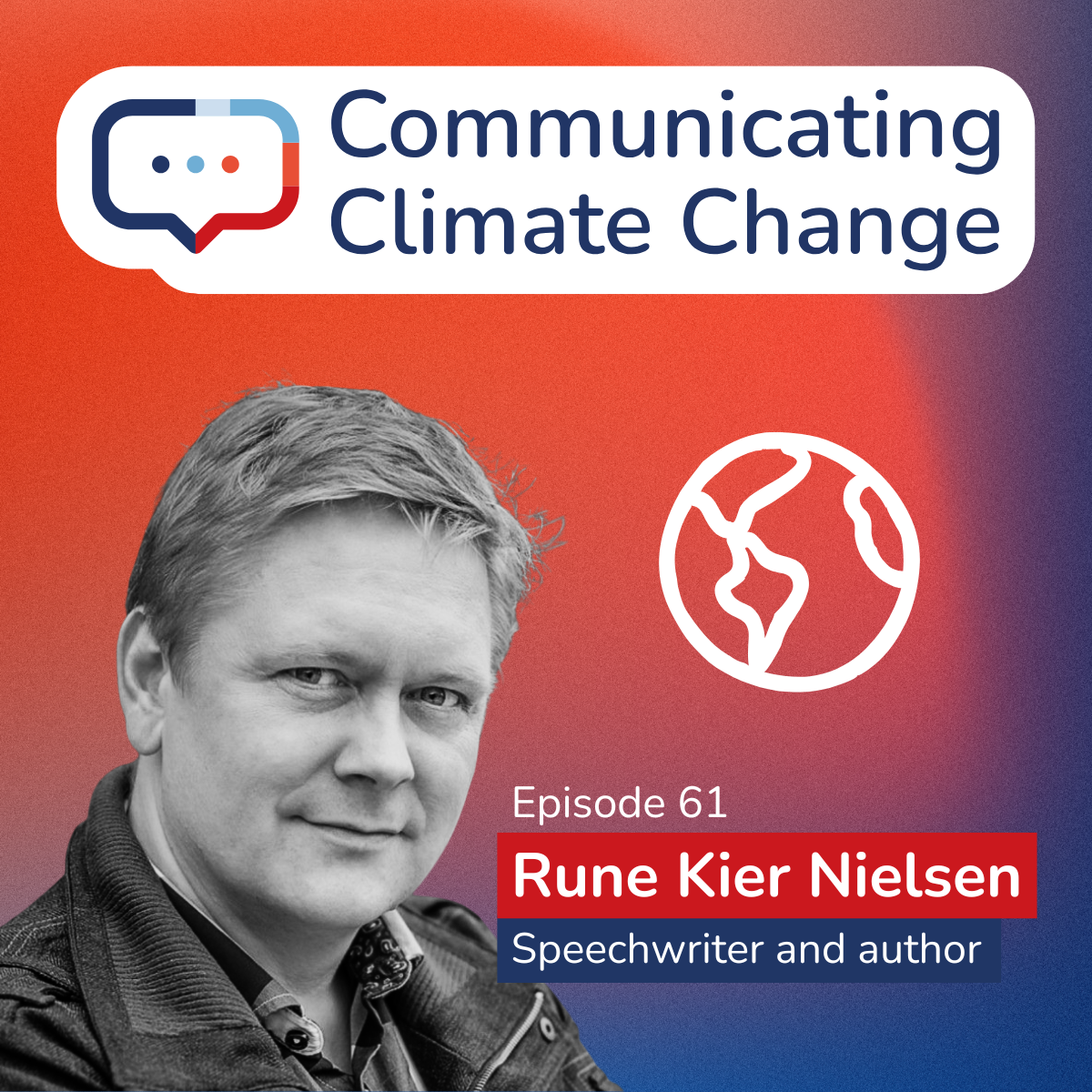
This episode features a conversation with award-winning speechwriter and author, Rune Kier Nielsen. It was recorded in June 2025.
Rune has worked across the public and private sectors, including within the Danish Government as well as leading Danish technology companies, and as Public Advocacy Lead on Climate Action at the UN Environment Programme, where he led campaigns such as ACT NOW: Speak Up, empowering youth and communities in developing countries to drive systemic change.
A two-time international Cicero Speechwriting Award winner, Rune has lectured widely and authored several books on climate speechwriting. Drawing on his background in Social Anthropology, he champions human-centered climate communication, guiding others to speak effectively about the world they want to see.
He currently works at VIA University College, Denmark’s largest and most international university college, where he develops engaging science communication strategies for the green transition.
I discovered Rune through his most recent book, Speaking on Climate: A Guide to Speechwriting for a Better Future, which I would recommend to all climate communicators, since it offers foundational insights that are valuable not only for speechwriting, but climate communications of all kinds.
Amongst other things, Rune and I discussed the mechanics of a powerful speech, where climate speeches have – and continue to – fall short, and the unique benefits this format offers for bringing people together and energising collective action.
Additional links
Visit Rune’s website
His latest book Speaking on Climate: A Guide to Speechwriting for a Better Future
Check out Rune’s video introduction to the book
Read the Kirkus review of the book here.
Find Rune’s book, Speaking on Climate, getting lots of love on We Don't Have Time
Dickon: Hi, and welcome to Communicating Climate Change, a podcast dedicated to helping you do exactly that. I'm Dickon, and I'll be your host as we dig deep into the best practices and the worst offences, always looking for ways to help you and me improve our abilities to engage, empower, and ultimately activate audiences on climate-related issues.
This episode features a conversation with award-winning speechwriter and author, Rune Kier Nielsen. It was recorded in June 2025.
Rune has worked across the public and private sectors, including within the Danish government, as well as at leading Danish technology companies, and as public advocacy lead on climate action at the UN Environment Programme, where he led campaigns like Act Now: Speak Up, empowering youth and communities in developing countries to drive systemic change.
A two-time International Cicero Speechwriting Award winner, Rune has lectured widely on climate speechwriting and has authored several books on the topic. Drawing on his background in social anthropology, he champions human-centred climate communication, guiding others to speak effectively about the world that they want to see.
He currently works at VIA University College, Denmark's largest and most international university college, where he develops engaging science communication strategies for the green transition.
I discovered Rune through his most recent book, entitled Speaking on Climate, A Guide to Speechwriting for a Better Future, which I would actually recommend to all climate communicators, since it offers foundational insights that are valuable not only for speechwriting, but climate communications of all kinds.
Amongst other things, Rune and I discussed the mechanics of a powerful speech. Where climate speeches have and continue to fall short, and the unique benefits that this format offers for bringing people together and energising collective action.
So let's get on with it. This is Communicating Climate Change with Rune Kier Nielsen.
From your perspective, how can communication best contribute in humanity's response to the climate crisis?
Rune: It's not easy because communication does so many things, but in my perspective, What's the most important thing that communication can do is collectivize. So right now, so many people are concerned about the climate crisis, but very few people actually talk about it and talk with others about their concerns, share concerns, solutions. So we really need to have communication that creates that kind of community around climate concerns and what we can do about it. That is the one thing that has spurred action at a large scale before.
Dickon: So then if we switch our focus to speeches, the subject of your fantastic book, in a world of short-form content, why do speeches still matter? What unique power do they hold when it comes to moving people on climate?
Rune: Goes down to the root of what a speech is and what it can do, what really brings it apart from other types of content, other channels of communication. And as far as I see it, is strategic, planned communication. mixed with in-person, one-on-one facial identification. And a good speech goes beyond the science and the facts and the information. It goes to the emotions and the humanity of people. So in my view, if we want to address people at a large scale, speeches is the way to do that.
It also does something different, which is it creates an occasion. somehow, you know, a social context, you gather, you listen, and it creates a whole special group social dynamics that you all know, you heard the same speech, and you can at least share what you heard. So it creates this third object that you can discuss, which makes it safer to discuss, but it also makes it more committed in terms of change, because What if somebody else in the audience all of a sudden asks, What are you gonna do? So there is this group dynamics that's added to the mix, but in our times of fast-paced digital content, micro content, it has the humanity to it that reminds us of, you know, stories being told around the campfire or big general... Alexander the Great leading battles and motivating people. So it has all those aspects to it and really condensed, humanized communication.
Dickon: Some of the most famous speeches that we're generally familiar with invoke stories from the past. What kinds of historical moments might be powerful for inspiring climate action today and why?
Rune: Climate action, of course, is a wide array of things. When I'm outside in the world giving workshops on climate communication, I usually have two groups of people that always show up. Those are the young vegans and vegetarians, Extinction Rebellion, Fridays for Future, and there are the grandparents. And that's two very different groups to talk to, but they get so much out of the interaction.
Because if what you want to do is get people to eat less meat, for instance, which is a perfectly valid climate action to take, what would you do? I would talk to my grandparents because they ate remarkably less meat than we did, and they felt that was completely natural. We are the exception. in this regard. So that would be where I would draw it.
But when we're talking more large-scale systemic actions, that's when it gets tricky. Where do you really find those moments that really changed us?
In Denmark, in the '70s, we had a big oil crisis. The oil prices swooped up in most of the Western world. In Denmark, we started making windmills. So of course, that's a powerful moment that I know has featured in many of my speeches, that we did that, there was a crisis, we acted, adapted, and we're better off for it. And that can go in many different directions, but it all depends on what change is you want. Because this, the windmills and the oil crisis in the '70s is a powerful example of We adapted and we grew economically.
But if you don't believe that economical growth is part of the solution, maybe it's even the problem, then there's different places that you need to look for for your inspiration, because it has to fit.
I usually use the hole in the ozone layer as my example. I believe that the climate crisis is best solved overall. by multilateral agreements and international commitments, action taken. And the hole in the ozone layer is an example of how that happened. And when you dive into it, there are all these elements that we can learn from. There's the popular pressure. There's the coordination of Friends of the Earth and Greenpeace and all these different NGOs. And there's these very conservative politicians coming together to actually save the world in a way that we very rarely see conservative politicians do today. So there's a lot of that.
But also it's an event that was very close to my heart because I remember it as a child. I remember the fear of the ozone layer cracking and all these terrible sunbeams hitting us and the feeling of being completely covered in sunscreen. So it has a rally, very emotional pull for me.
But it really comes down to what needs to happen and when has it happened before. And I think a lot of the times we don't see the big changes. We see the Civil Rights movement, we see the Suffragettes, and we can learn so much from them. There is a need to talk more about when the world has changed for the better and how we have created that change, or adapted to that change, and what we can learn.
There's a tendency in the climate debate, in my opinion, to look at 2050, at 2100, at 100 years from now, but we're not looking back. If you're not looking back at all, you have a tendency to see the rupture happening as something bad. You will lose, if not anything else, at least the comfort of the known", for something else. But if you look back and see that this is really just a row of different changes, then it's a completely different ballgame.
Dickon: Yeah, we've done this before. We can do it again.
Rune: Exactly. It's that feeling. Radical changes has happened before. And we have adapted and benefited from them at times. And today, we need to have that mentality again.
Dickon: One of the stories, I suppose, that we often see brought up, whether that's in promotion of the Green New Deal in the previous US administration, or indeed, it's often brought up in the UK, where I'm from, and that's World War II. But why are framings like battles, wars, or even the idea of things that are unprecedented, better off being avoided, actually? What problems do they bring to the table? And what should we use instead?
Rune: The part about unprecedented revolutions or transformations needing to happen is that when something is unprecedented, it means we don't have a precedent. So we don't have anywhere to draw inspiration from. It's that straightforward. And when we don't have anywhere to draw inspiration from, we dive into the pit of despair saying we can't do it. We've never done it before. That's that one. And that goes for being historic, or the greatest crisis in the history of humanity, or all these things. We effectively cut off the opportunity of learning from the past. And we shouldn't do that because we all need to have something to build on, something we can learn from. It doesn't have to be identical, but it should be something we can learn from.
Now, when it comes to all these wartime metaphors that we use, That was a very interesting piece of research I read that said, Once you use battle or war metaphors, you are often very good at rallying the people who believe what you believe, and you are effectively rallying them for instant, short-term, high-risk action. You know, the picture is a war. You dive in, you fight to the death, and you hope you live. It better be something you believe in deeply. Otherwise, what are you doing? And it better end fast. You can't keep fighting forever. So that's the big trade-off that you do. If you use a rallying cry using battle and war metaphors, it has to end soon. You have to win it and go home and enjoy the spoils. Even in my book, I have the example of Alexander the Great, who gave a marvellous speech using all the tools of Aristotle, and the soldiers didn't care, and they went home anyway. Because you can't keep being in a war. It has to normalise at some point.
And then there's the other metaphor that a lot of people use, which is the race to zero, the race to resilience, the race to combat the climate crisis. The race metaphor has some very different attributes. It's not so high risk, you know. Imagine running a race that you win, you lose. Well, you know, I hope I'm better next time. I'll come back next year. You don't have to be so persuaded, you don't have to choose the high risk path. And those are positives. On the other hand, it doesn't mean so much, and you don't fight till the death. And it's not so a massive change. But it can be a prolonged. So when people are saying, you know, it's not a battle, it's a marathon. Well, that's really what they're saying, that it's not instant high risk. We'll have to moderate. We'll have to come back tomorrow. We'll become better and better and better. is this is a long-term game.
And those are some of the things I'm trying hard in this interview and in the book as well to not say what is the best, because that depends a lot on who you're talking to. But to an even larger extent, I want people to form their own opinions. We need the all-time high-risk actions of a battle, the radical transformation with the long-term view. that this won't happen tomorrow or the day after. It might even not happen in our lifetimes. It'll be something continuous. But how to mix those two in the best possible way, that's a hard one.
Dickon: But if we then move on to the nuts and bolts of a speech, I suppose, we've talked about kind of context, things to invoke. I want to get into the actual body parts, the connective tissue. So how do you use the likes of rhythm, repetition, or even silence in speeches and how can communicators use them without sounding artificial?
Rune: They are important tool and they have been for the last 2,500 years. intrinsically part of rhetoric and communication. And, you know, you don't see a commercial without some kind of rhyme, Biden will build back better, and Trump's MAGA and all these things. They have an important role to play.
On the other hand, you don't want to sound artificial or like you're giving a spoken word poem or something. It's kind of like spice when you're cooking. You need the right amount of the right places to really bring forward the flavors that you want. And with that metaphor, I like that you are speaking in a speech plain, that you are voicing what you think. And then once you've identified that this sentence is really the key message to remember, that's when you sprinkle rhetoric. And when you make sure that this sounds good and people will remember it. Because these things with repetition and rhyme and rhythm and all these things are mnemonic devices designed for you to remember them better. and design for the audience to remember them better and hopefully pass them on. So you want to put it on the right parts of your speech.
I like the idea of refrain in a speech where the way you come back to the same, maybe slightly reformulated idea again and again, so that people know that's the important part. I usually say that I try to live by the rule when I'm writing speeches that It can be any name. Let's call it the Charles and Julie rule. Charles and Julie are coming to the speech. They're sitting in the audience. But right before it starts, Charles has to take a phone call or go to the bathroom, and he doesn't return until the speech is over. And he asks Julie, what was the speech about? And that one sentence that she will give him on the way to the car is what you have to decide. And you have to make sure that she knows that's the one. And you have to sprinkle it with repetition and rhyme and rhythm so that it's easy for her to remember, that it stands out. And that's really your purpose with using these tools.
And the difficult thing is making sure that it's the right one and making sure it's only that one. I give the example in the book that Martin Luther King, he did it wrong in the I Have a Dream speech. that he gave two speeches. He gave one about the whirlwind of revolt and the blood in the streets and we'll never forget and go back and mobilize and the freedom being at check, but the bank of justice being bankrupt and, you know, very powerful language, really something you would remember. But then he skipped into a sermon about a dream and a table of brotherhood, and that's what people remember now. So I can't speak for Martin Luther King, but if I was him, I would be pretty disappointed that I had used so much time designing a speech. And what people remembered was something completely different. And there are tons of examples of this that, you know, a small sentence is taken somewhat out of context because it was catchy and used as the message of some piece of communication. So you really want to make sure that it's the right part that you highlight.
Dickon: I'm just thinking about a speech that I've mentioned before on this podcast. I'd be interested to hear your take. I guess this may or may not make its way into the episode. There's a Simon Stiele speech, “Two Years to Save the Planet”. I don't know if you know that speech? It was at Chatham House a couple of years ago. The whole headline at the time was “two years to save the planet”. That is the thing that he kept coming back to in the speech. Having spoken to neuroscientists about it in the time since, it's also sort of not a great thing, necessarily, to take away because we're coming up to about two years since that speech and we haven't saved the planet. So does that mean we're doomed? I just wondered if you were familiar with that speech and if so, if you had any comments on it.
Rune: I don't have it crisp in my head, but I do agree that that as a headline or as a message is bad. You know, it's urgency without direction. We need to move fast. Yes. In what direction? What do we need to do? Give me something.
But it is a difficult one. Now, I worked in the UN and I've listened to a lot of Antonio Gutierrez's speeches, and he has very forceful metaphors that he uses. And at times, I think he's going a bit overboard. with biblical references and apocalypse and collapse and humanity being at war with nature. And it's very tough, very, very committed. But he also has to, you know, scale it up a bit each year. So that will be the direction he's heading.
But in the end, we come up with so many different metaphors that it becomes a mishmash in our heads and we can't really figure out what is he really saying. a suicidal war against nature. Do we want to win or don't we want to win? Is this an apocalypse? Well, if it's an apocalypse, is it biblical? Does that mean we're fighting against God? Do we want to win? Do you wanna win against God? Shouldn't we let him win? Do we even have agency in terms of an apocalypse? That's, you know, God punishing us for something. There's so many implications to these metaphors that you have to take into account.
And when you're speaking to a global audience, it's also the fact that people understand this, vastly different. If you are a devoted Catholic, hearing that the climate apocalypse is coming, holy moly, Okay, so we need to prepare. Have you said your prayers?
On the other hand, when you're talking sustainable development goals, I spoke to a speechwriter in Africa, at one point, Central Africa, and she said, “Yes, I don't want to talk anything more about development. Development has been used by European colonizers of Africa for forever, and it never means to our benefit. It always means to your benefit. and always means that we have to do less of something that we always did, you know, less tradition, more development. No, we want to build on our traditions. We don't want your development.” So even a concept like development, which to me at the time seemed pretty neutral, has very strong implications.
Dickon: I'm going to move on to props then. This is a thing that came up in the book that I really love. And it made me think about the classic snowball brought into the US House or perhaps Congress, I forget. But could you share an example where using a prop made a speech more impactful?
Rune: The prop as a tool is very good at getting attention and making people think like, “But wait, what is that?” So that's one way to use it.
What it also can do is it can remind people of your message afterwards, which is something I think a lot of people forget.
So I mentioned in the book, Bill Gates's TED talk about malaria and combating that, where he actually releases mosquitoes into the room. I guarantee you people were just sitting up at that point. I guarantee you when they heard a mosquito while camping in a tent a few weeks later, they would remember malaria and the dangers associated with it. So that was a very good use of tool. We don't always have mosquitoes in boxers to release, but we might have other things.
I myself wrote a speech on climate and shrinking ice at the Arctic and stuff like that, I mention it in the book, I didn't want to give the minister some prop that he would probably forget and the speech would collapse. So I researched what would be available when people would be listening to him. And I discovered they would have a certain size of glass, a glass of water. And then I use that as a metaphor saying, okay, so this is how much ice melts away from the Arctic every single year. You, while this speech is going on, will be like 10 minutes, you can drink this much water. And that's perhaps perfectly fine. You might be thirsty, but you can't keep drinking it. The ice is not stopping from melting. At some point you will be completely full and it'll be starting to be a health issue for you. And that's where we are with the earth right now. So connecting the message to something that was in front of them and it was theirs, and when they would be drinking later, maybe they would be thinking about that message as well, hopefully. That's how I think tools should work. You know, make be an eye opener, but also be a reminder afterwards.
Dickon: What have you learned about what separates a good speech on paper from one that actually lands when it matters?
Rune: What I have learned is that, for instance, you might sprinkle rhetorical devices all over the speech, and it'll look like almost a poem. It will look like a piece of art. And on paper, people will say, “Oh, he's using that, he's using that, and this, oh, this is good.” And it might have a little storytelling, it might have a little anecdote, a little humour in the end, stuff like that, a clear call to action. You know, all the checkpoints are hit.
But a good speech is a speech that makes the audience and the speaker resonate as human beings. And that's incredibly hard, really, to measure when that happens. Because a lot of it is in the delivery of the speech. You know, do you really feel this anecdote? So one of the things that I do to see if it worked, and I actually encourage everybody I help with speechwriting to do that, is measure it in terms of, do people approach you afterwards? Do they want to talk to you? Because if you came across as a full human being that they could identify with, that's probably going to be their reaction. They're going to approach you at the bar or while you're having lunch or when you're coming down the stage and ask you some questions or relate to you that they have experienced something similar or something along those lines. So that's one way to very concretely try to see. This is not about what's on paper, it's about the human interaction afterwards.
Another thing is, you know, at times, I kind of tiptoed around listening. You know, a speechwriter, nobody knows what I look like. So tiptoeing around, listening, what are people chatting about afterwards? What parts of the speech, perhaps, or are they already discussing what they want for lunch? That's one way. And I've also tried to make sure that the speech is linked, perhaps with a hashtag or something, so that I could monitor on social media. Are people actually sharing about the right messages, the ones that I wanted them to share about? Or are we somehow off topic?
I came to speechwriting not as a journalist or a communications guy. I came from social anthropology. So I had studied social movements in Brazil, particularly, before I even started writing speeches. And while there, I interviewed people who had changed, who had made a radical change in their lives. And I asked them, What made it? What pushed you? What stimulated that change for you? It changed them completely. You know, it was a change of network. It was a change of what past do I identify with. It was a change of hair. and clothing and fashion, you know. Before you might have straightened your hair as a black guy or cut it entirely off. Now you would be having dreadlocks or braids or an afro. Even religion would be changed by this shift because you might have been Catholic before, a Protestant, Christian. All of a sudden you would change to umbande or candomble or some of these African-inspired religions. And slowly, I started finding similarities in what stories changed, the ones who have actually been changed. And I found that they have to be highly personal. They have to address some of our collective concerns. In my work in Brazil, it was the consequences of racism in a society that denies its existence. They talked about, yes, as a young person, I heard this speech and it really made me think, but it took years for me to navigate the different networks that we have, because we have to remember that when we're giving a speech urging people to change, if they actually want to, then they will leave the room and go back into exactly the same families, the same friends networks, the same colleagues that they were before, and they will expect exactly the same person.
So change is very hard and it takes a lot of time. So we also have to say that an effective speech that changes something, does something, the change might not be visible for five to 10 years, but that also means that it might be a deeper change than just persuasion. If you want a radical change, it's a certain kind of communication that can do that, and it has to be deep felt and it relies a lot on the person standing on the stage saying the words, which is also one of the reasons why I think it's so important that we as devoted climate warriors or whatever we call ourselves, stop just saying what it looks like from our perspective now and start saying, “I haven't always been like I am now. I have also been persuaded. I have also changed, taken a path that led me to here. Let me tell you where I started and what changed me.” Because those are actually, that's what I learned in Brazil. Those are the kind of stories that change people. We mirror our experience in the others. I follow your journey.
Dickon: So, what changes when you're writing for a global audience, where, as you sort of mentioned earlier, particular metaphors and values might not always travel well? What are some of the risks or unintended consequences when your audience isn't just the people in the room, but also those out on the internet being exposed to the messages of that speech after the fact?
Rune: Some of the things that doesn't travel well are you know, very cultural specific stuff. I come from Denmark. In a Danish context, I could talk about the glory of the Vikings. It might not sound like that for the French coast or somewhere that didn't enjoy that quite as much. So there are certain aspects like that. And values, too.
We spoke earlier about Antonio Gutierrez's speeches being very biblical, very focused on that because he is a devout Portuguese Catholic. So that makes sense for him. But for many people that are not particularly religious or even Christian, that might sound strange, and it will not resonate quite as well. So I often try to say, What are you saying with that climate apocalypse? Okay, strong word will not resonate so well with certain religious groups. What can we say that hits on the value that the apocalypse? Okay, we are approaching a massive consequences of our actions that have been accumulated and we haven't addressed them. But so you can reframe them because the values underneath are human values. And everybody wants to protect the next generation. Nobody likes that there are no fish in the lake when there used to be. Nobody likes that the forests are disappearing. Nobody likes that the coast is being eroded because of sea level rise. These aspects are all mutual human concerns.
What I'm more concerned about is our inclination to live in bubbles and think that everybody lives the same lives that we do. Now, when I started working in the UN, we have a big campaign, the UN campaign, Act Now, individual climate campaign across all of UN, and extremely science-based, what can you do that has the largest impact? And they are good comments. Make sure that you change your power provider to a sustainable source. Make sure that you use fossil fuel transportations as little as possible, and don't go on any airplane trips. Make sure to eat less meat in your diet. Three great science-based focused things… for a Western middle class group.
It's crazy to see how few people that really addresses. Like electricity, half of the world, approximately, lives either without electricity or without any kind of power in where it comes from. Planes and cars? 80% of the world has never been on a plane. Even meat, like we said before, you know, an average Westerner eats 100 kilos of meat a year. An average African or South Asian eats 10. So maybe there are certain groups that we should ask these changes of, and not everybody. Maybe there are more impactful ways that they can act.
And I feel actually that speeches, the advocacy inherent in a speech, is something everybody can get on board with. You know, everybody, regardless of your source of energy or your income level or your diet, can speak up about what they think about the climate crisis and ask people to collectivise and come together and actually push for action by Whoever can make it, whether it's big corporations or it's the government or it's your school, you can always push for change. And that doesn't have anything to do with your diet, your transport habits, or where your energy comes from. So it's a much more democratic way of actually creating change, in my view.
Dickon: What's the single most important aspect of communication that we should be paying attention to in our climate communication endeavours?
Rune: The single most important thing in climate change communication, in my view, is that we have to stop making it sound like we are lecturing from a chemistry class. We have to make sure that people can engage in this conversation and be part of the solution without having a PhD in chemistry or physics. It has to go beyond science. I firmly believe that science had a time where we needed to agree that there's a consensus and we need to act. But I firmly believe we're there.
We need now to engage the entire population, also the people for whom science is why they never got into school or had any kind of learning in that regard, because we exclude too many people from the conversation because they can't participate. And there's another huge chunk of people that says, Oh, so this is a science question. We'll leave it to the scientists. And that's not how we create the change we want. So we have to start sounding like humans and engaging others as humans. That's what we have in common, and that's how we get this thing.
Dickon: What's the biggest mistake that you see communicators make when attempting to engage the public on climate change issues?
Rune: Well, I guess one part is what I said before, that they tend to sound like a science lecture. And that's too bad. But the other flip side of that coin, of course, is that some people start talking down to others and engaging and thinking they can't understand the dynamics just because they are not entirely sure if 50 gigatons of hot air CO2 is a lot or not. So we really have to find a balance between understanding what's at stake without making it a science lecture. I think that's the absolute most powerful thing that we invite people in through identification and stories and emotions, real human emotions, instead of asking them to be a calculator and just giving them the numbers and you do the math. That's not how we create change.
Dickon: It was awesome talking to Rune for this episode, but what in particular stuck with you from our conversation? What will you take from it and apply it to your own work?
For me, it was the outsized influence that metaphor has on the way a speech might be received. That distinction that Rune shared between a war and a race, and the way these framings potentially lock us in to limited future options, should we not want to leave our audience confused in the long run. It reminded me of my conversation with Laura Santamaria about semiotics, the way that different people exposed to the same information or symbols or colours might have completely different mental connections associated with those things. Metaphors, it seems, are much the same.
And then there's that tricky balance between rhetorical devices like rhythm, rhyme, repetition, and the very personal human magic of anecdotes and emotional delivery. It might be a perfect speech on paper, but completely miss the mark if its delivery is weak. Knowing your speaker then, and ensuring that the speech matches their energy, their passion, their experience, all that stuff will be important to get right and align.
Finally, I loved the idea of speeches laying the groundwork for deeper, longer-term change, like sowing a seed in people or something. Just like a butterfly flapping its wings and creating a typhoon on the other side of the world, history shows us that even a speech that'll end up being remembered for the catchy refrain rather than the potent substance can still end up fueling a revolution. So that's what I'll be taking with me.
But how about you? What did you hear? What will you be incorporating into your communications endeavours?
Thanks to Rune Kier Nielsen for sharing his time and insight with the show. It was great. You can find links to some relevant resources in the show notes. Thanks also to you for listening to Communicating Climate Change. If you enjoyed this episode, why not leave it a rating or a review?
Your feedback not only helps to shine a light on the guests and themes that resonate with you the most, but also boosts visibility, meaning the series reaches more people, expanding the community and driving the conversation forward. After all, that's what it's all about.
You can find more episodes wherever you get your podcasts or by subscribing so you never miss out. You can find Communicating Climate Change on LinkedIn too. And if you think the series would be of interest to friends or colleagues, why not point them in the right direction?
Remember, each and every episode attempts to add to our toolkits to help us develop the methods and the magic that we'll need for this oh-so-human task. So be sure to stay tuned for more.
For anything else, just head over to communicatingclimatechange.com.
Until next time, take care.